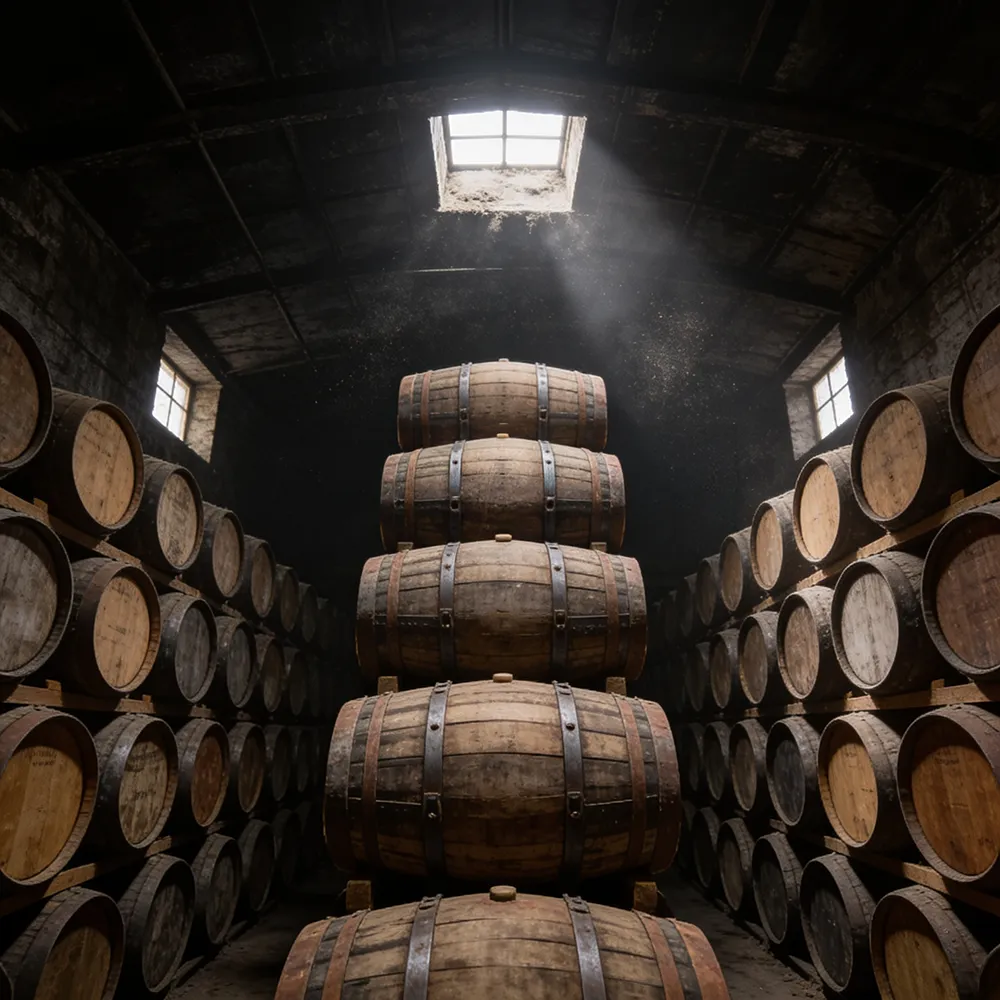
Every year, around 2% of the liquid in each of our casks evaporates through the wood and into the air of the warehouse. This is the angel's share — the portion that, as the old saying goes, the angels take as their tithe.
Two percent sounds modest. Compound it over fifteen years and you have lost approximately 26% of your original fill. A 200-litre cask filled in 2010 contains roughly 148 litres today. That evaporation is not loss — it is transformation. But it is worth understanding precisely what is happening and why it matters more here than it does in a lowland Scottish or Irish distillery.
What Evaporates
The rate of evaporation depends on temperature, humidity and the porosity of the wood. In warm, dry conditions, water evaporates faster than alcohol, and the whisky increases in ABV as it ages — this is what happens in Kentucky bourbon warehouses, where summer temperatures can reach 40°C. In cool, humid conditions, alcohol evaporates faster than water, and the whisky softens and reduces in strength over time.
Glen Moriston sits at around 280 metres above sea level. The average annual temperature is 8°C. Humidity in the warehouses, which are built into the hillside, runs consistently between 75 and 85%. This is ideal for whisky maturation — the spirit loses strength slowly, integrates gently with the wood, and develops complexity without the hard-edged rapid extraction you get from temperature cycling.
Why Highland Distilleries Lose More
The 2% figure we see at Meridian Cask is higher than the Scottish average of around 1.5–2%. The reason is elevation and wind exposure. Our site is more exposed than valley-floor distilleries, and the temperature fluctuation — while not extreme — is greater than you would find closer to sea level. This drives more evaporation through the wood as the cask breathes with temperature changes.
A higher angel's share is not a problem. It is a cost. And it is a cost that comes with a product of demonstrably different character than whisky matured in more sheltered, consistent conditions. We have no intention of moving our warehouses.