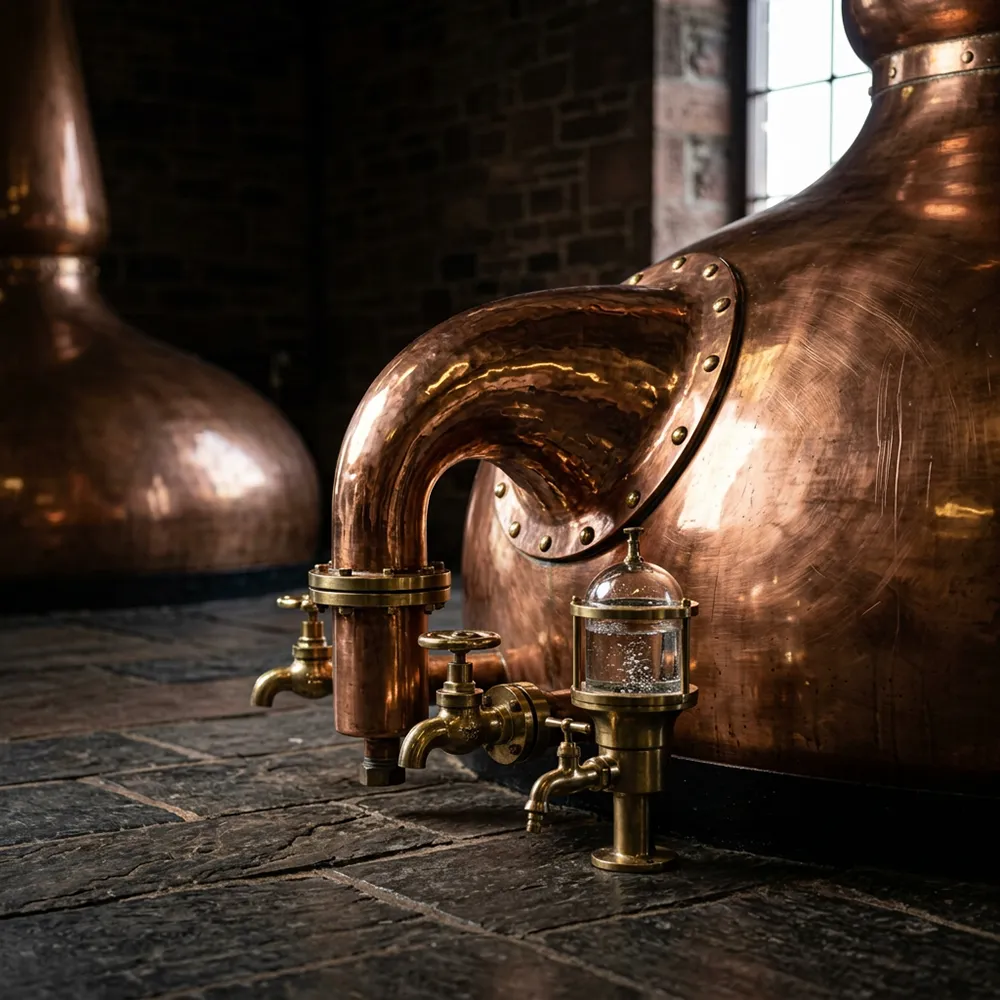
The copper pot stills at Meridian Cask were cast in Inverness in 1895. They have been repaired fourteen times. They have had new necks fitted twice, new swan arms once, and new onion-shaped bases more times than our records accurately document. They are not the same stills they were in 1895 — in the way that a ship restored plank by plank is not quite the same ship it started as.
But they are the same shape. And in pot still distillation, shape is everything.
What Shape Does
The geometry of a pot still determines what compounds survive the distillation process and which are lost. A tall, narrow still with a long neck allows more reflux — the heavier, oilier compounds fall back down before they can make it over the lyne arm. The result is a lighter, more delicate spirit. A short, squat still with a broad neck produces a heavier spirit with more texture and weight.
Our wash still is 12,000 litres with a relatively short neck. Our spirit still is 7,500 litres with a pronounced waist and a long descending lyne arm. The combination produces a medium-bodied spirit with good fruity esters and enough weight to carry long maturation. Change either still — even to an identical specification — and you change the spirit. The copper itself matters. The microscopic variations in the surface matter. There is no way to replicate this precisely.
The 2003 Repair
In 2003, a fault appeared in the lower section of the wash still — a stress fracture caused by a thermal shock incident the previous winter. The repair required a section of copper to be cut out and replaced. We debated at length whether to replace the entire base, which would have been cheaper. We chose to repair only what was damaged.
The 2003 repair is still visible if you know where to look — a slightly different patina on the lower right quadrant of the wash still. Some of our staff call it the scar. We think of it differently. It is evidence of a decision made correctly under financial pressure. That kind of decision is what a distillery's character is made of.
Why Replacement Is Never Discussed
When the distillery changed hands in 2009, the purchase agreement included a clause prohibiting the replacement of either copper pot still without unanimous agreement of all ownership partners. It was the condition insisted upon by the outgoing family.
We have never needed to invoke it. The idea of replacing the stills has not seriously arisen. The stills are not infrastructure. They are the reason the whisky tastes the way it does. Replacing them would be replacing the distillery itself.